


-RGB.1708361192.png)
Facilities Managers: How Often Should Commercial Drains Be Surveyed?
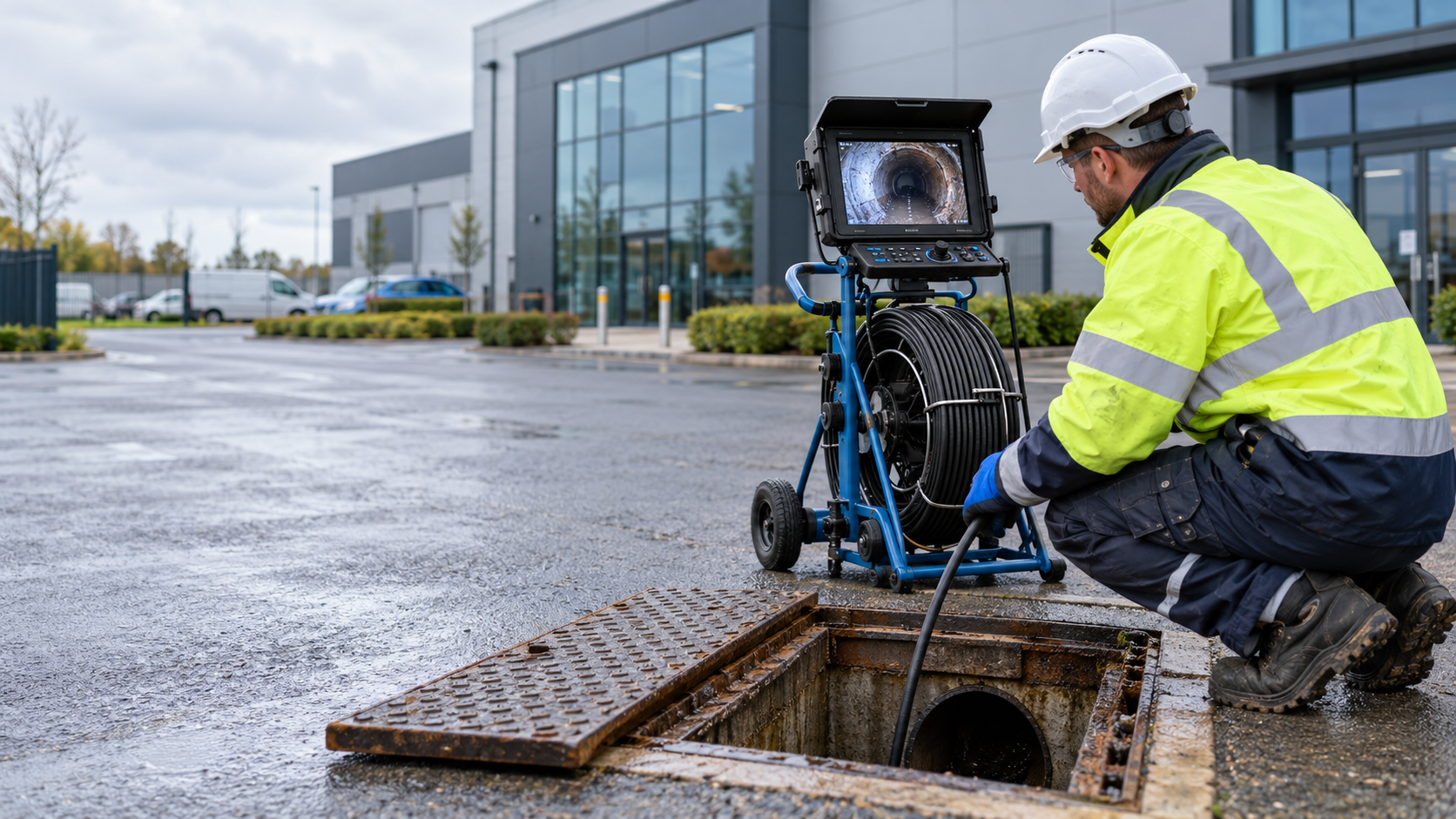
Most commercial drains only get looked at when something goes wrong. A toilet backs up, a manhole overflows in the car park, or the kitchen floor gully starts to smell. By then you’re paying for an emergency call-out instead of a planned visit.
A regular survey lets you spot problems while they’re still small and cheap to fix. How often you need one depends on your site. This guide covers what changes the answer, some typical starting points, and how to build surveys into your maintenance plan.
Need help right now?
Call 0203 870 1067. We carry out commercial CCTV drain surveys for offices, retail, hospitality, schools and industrial sites.
Why regular surveys matter
Underground pipes are out of sight, so it’s easy to forget about them. But they wear just like any other part of your building. Cracks spread, joints slip, roots creep in and fat builds up on the pipe walls.
A camera survey shows you what’s happening inside the pipe without any digging. If you’re not sure how they work, our guide What Is a CCTV Drain Survey and Do You Actually Need One? explains the basics.
For facilities managers, a survey gives you:
- A clear picture of the drain’s condition
- Early warning of defects before they cause a blockage or collapse
- Evidence for budgets, insurers and landlords
- A record you can compare against next time
What affects how often you should survey
No single interval works for every site. These are the main things to think about:
- What goes down the drains. Commercial kitchens send fat, oil and grease into the system. Industrial sites can send grit, silt or chemicals.
- How busy the site is. More people means more flow and more wear.
- The age of the pipes. Older clay pipes are more likely to crack or have slipped joints.
- Trees nearby. Roots look for water and can get into even small cracks.
- Past problems. If a drain has blocked before, there’s usually a reason.
- What a failure would cost. A blocked drain at a busy hospital or shopping centre causes a lot more disruption than one at a small office.
Typical survey frequencies
These are general starting points rather than legal requirements. Your first survey will tell you whether to survey more or less often.
| Site type | Suggested starting point |
|---|---|
| High-risk sites: commercial kitchens, food production, sites with a history of blockages | Every 12 months |
| Medium-risk sites: retail, schools, hotels, busy offices | Every 2 to 3 years |
| Lower-risk sites: newer buildings with light use and no past problems | Every 3 to 5 years |
On top of this, it’s worth booking a survey:
- When you take over a new site or contract
- Before and after building work
- After heavy rain or flooding (see Why UK Drains Are Struggling With This Year’s Rainfall)
- After any repair, to check it’s been done properly
- When the same drain keeps blocking
Signs a survey can’t wait
Don’t wait for the next scheduled survey if you notice any of these:
- Drains that keep blocking, even after they’ve been cleared
- Bad smells around gullies, toilets or manholes
- Slow-draining sinks and toilets across more than one area
- Sinking paving, damp patches or cracks near drain runs
- Manholes filling up or overflowing (here’s what to do if a manhole overflows in your car park or yard)
- Rats around the building
For more warning signs, read 7 Signs Your Drains Need a Professional Clean.
How to build surveys into your maintenance plan
- Start with a baseline survey. A full drain condition survey shows you where you’re starting from.
- Map the system. Many sites don’t have accurate drainage plans. Drain mapping and tracing shows where every pipe runs and where it connects.
- Build an asset register. A drainage asset register keeps every pipe, manhole and defect on record in one place.
- Set your survey frequency by risk. Use the table above as a guide, then adjust it using what the first survey finds.
- Combine surveys with planned cleaning. Pairing surveys with water jetting clears build-up and gives the camera a clear view of the pipe.
- Deal with defects early. Small cracks and displaced joints can often be fixed with drain lining and relining, with no need to dig.
- Keep the paperwork. Service reports with photos give you a clear record for audits, insurers and clients.
Managing more than one site?
If you look after a portfolio, put every site on the same schedule and use the same report format for each one. That makes it easier to compare sites and plan your budget. Our multi-site drainage contracts and facilities management support are set up for this. We can also work out of hours so surveys don’t disrupt your tenants or customers.
Commercial kitchens need a separate plan for grease. See Grease Trap Servicing: How Often Does Your Restaurant Actually Need It? and our grease traps and interceptors service.
The bottom line
For most commercial sites, a survey every one to five years is a good starting point, and high-risk sites should be surveyed more often. A baseline survey followed by a schedule based on risk usually costs less than waiting for a blockage and paying for an emergency call-out.
Contact us today
Want to set up a survey schedule for your site or portfolio? Call 0203 870 1067 or email contactus@icedrainage.co.uk and we’ll help you plan it.

Speak with me today,
I’m here to help
By asking you a few questions either via phone or email I can immediately provide a realistic estimation of the cost.
You’re in good company. We’ve worked with the following commercial clients… View all



















Why choose us?
- Cater to a wide variety of drainage situations
- Nationwide coverage, available 24/7
- Cater to commercial and domestic clients
- Free survey provided prior to quotation
- Emergency response team
- Offer a bespoke service designed to suit all your needs
- All technicians hold professional health and safety qualifications