


Do You Need a Grease Trap? UK Rules for Food Businesses
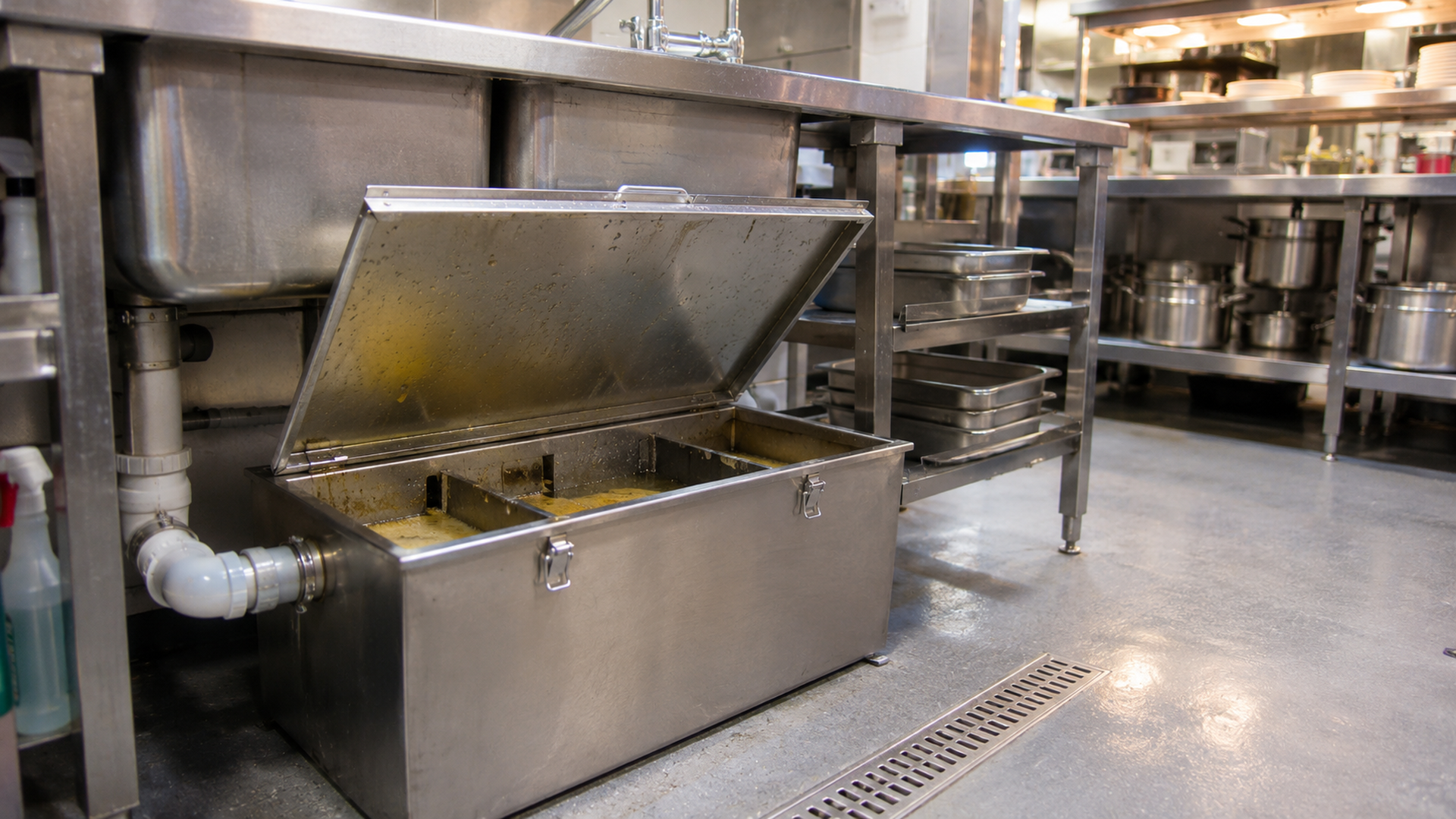
If you're opening a café, takeaway, restaurant or pub kitchen, someone will ask you about grease traps. Your landlord, your fit-out team, building control or the water company.
So do you legally need one? The real answer is "probably, yes". But it isn't as simple as a single law that says "every kitchen must have a grease trap".
Here's what the rules actually say, in plain English. This covers England. Rules in Scotland, Wales and Northern Ireland are similar, but check with your local water company.
The short answer
There's no single law that names grease traps and says every food business must have one. But two sets of rules mean most commercial kitchens need some way of stopping grease getting into the drains.
- It's an offence to put anything into a public sewer that could block it or stop it flowing. That comes from the Water Industry Act 1991. Fat, oil and grease (FOG) is the main thing that does this.
- Building Regulations expect new commercial kitchens to have grease removal. Approved Document H says drains serving commercial hot food premises should have a grease separator, or another effective way of removing grease.
So, for most food businesses, the question isn't "do I need something?" It's "what's the right thing for my kitchen?"
Who needs grease removal?
If you cook, serve or wash up hot food on a commercial scale, assume you do. That includes:
- Restaurants, cafés and takeaways
- Pubs and bars serving food
- Hotel kitchens
- School, hospital and care home kitchens
- Staff canteens
- Food production units
- Mobile catering units that wash up on site
A business that only reheats sealed food may not create much grease. But if you're frying, roasting or washing greasy pans, you're producing FOG.
What happens if you don't have one?
Grease cools in the pipes and sticks to the walls. Over weeks and months, it narrows the pipe until it blocks. We go into this in what actually happens when you pour fat down the sink.
For a food business, that can mean:
- Blocked drains and flooded kitchens, often on your busiest night
- Bad smells that customers notice
- Visits from the water company if grease from your site blocks the sewer
- Costs for clearing the sewer passed back to you
- Problems with your landlord or insurer
We cover the enforcement side in what restaurants get fined for.
Grease trap, grease separator or grease recovery unit?
People use these words loosely, but they're different things.
Passive grease trap
A box, usually under the sink, that slows the water down. Grease floats to the top and is held back. It's simple and cheap. It needs emptying often, sometimes weekly in a busy kitchen.
Grease separator
A larger tank, usually below ground outside, built to a recognised standard (BS EN 1825). It handles the flow from a whole kitchen. It's common in larger restaurants, hotels and new builds. See our grease separator installation.
Grease recovery unit (GRU)
An automatic unit that skims off the grease into a container. It takes up little space and you empty the container rather than the whole unit. It needs regular servicing to keep working. See our grease recovery unit servicing.
How to choose the right one
The right choice depends on:
- How many meals you serve. More covers means more grease.
- What you cook. Fried and roasted food produces far more FOG than a salad bar.
- How much space you have. Under-sink, in a plant room or outside below ground.
- Who will empty it. A small trap emptied daily by staff, or a bigger unit emptied by a contractor.
- What your landlord, building control or water company asks for. Some ask for a specific type or standard.
Get this wrong and you'll either pay too much or end up with a trap that's too small and overflows. A site survey before you fit out saves a lot of hassle. Our grease trap installation starts with one.
A grease trap only works if it's emptied
This is where most kitchens slip up. A full trap lets grease pass straight through, so it's doing nothing.
Set a schedule from day one. How often depends on size and how busy you are. Our guide on how often a restaurant needs grease trap servicing has the details. Keep every service record and waste transfer note. If the water company or council asks, those records are your proof.
Our grease trap emptying and cleaning and grease trap servicing keep it on track.
Good kitchen habits still matter
A grease trap is the last line of defence, not the only one. Train your team to:
- Scrape plates into the food bin
- Wipe greasy pans with paper before washing
- Collect used cooking oil for recycling, never pour it down a sink
- Use sink strainers
- Report slow drains straight away
Opening a new kitchen?
Talk to us before the fit-out, not after. It's much cheaper to put the right grease removal in at the start than to dig up a new floor later. Call 0203 870 1067, email contactus@icedrainage.co.uk or get a quote today. We start with a free site survey.
Related reading: fat, oil and grease management.
You’re in good company. We’ve worked with the following commercial clients… View all














Why choose us?
- Cater to a wide variety of drainage situations
- Nationwide coverage, available 24/7
- Cater to commercial and domestic clients
- Free survey provided prior to quotation
- Emergency response team
- Offer a bespoke service designed to suit all your needs
- All technicians hold professional health and safety qualifications